
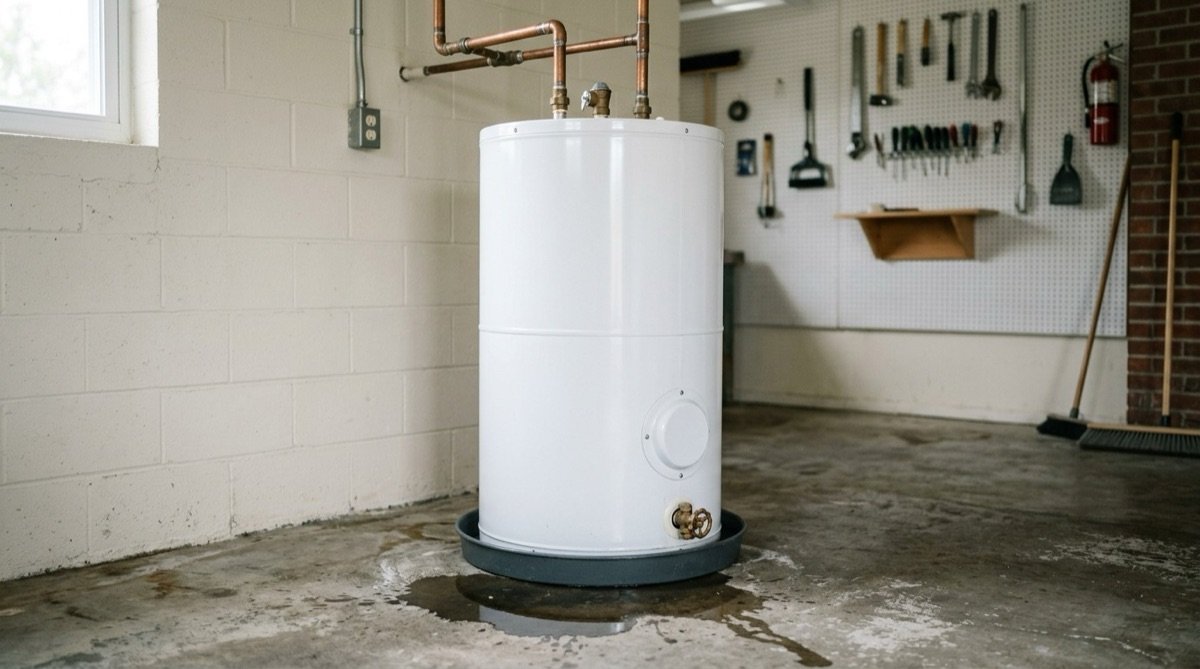
Finding a puddle around the base of your water heater is stressful. Is it about to burst? Do you need a new one today? Take a breath. A water heater leaking from the bottom isn’t always a disaster. Sometimes it’s a loose valve or water dripping down from above. But it’s worth finding the cause quickly, because some leaks only get worse.
Quick answer: turn off the power or gas and the cold water supply first. Then check whether the water is coming from the drain valve, the pressure relief valve pipe, or a connection at the top running down. If the tank itself is leaking from the bottom, it usually needs replacing.
First, make it safe
- Turn off the energy source. For an electric water heater, switch off its circuit breaker. For a gas water heater, turn the gas control knob to OFF or PILOT, following the label on the heater.
- Turn off the cold water supply. The valve is on the cold water pipe going into the top of the heater. Turn it clockwise until it stops.
- Be careful of hot water. The water inside can be hot enough to scald. Let it cool before touching valves or pipes.
- Protect the area. Move anything valuable away and put down towels or a tray.
If water is spraying, or you see gas smells or scorch marks, leave it to a professional. If you smell gas, leave the house and call your gas company from outside.
Find where the water is really coming from
Dry the area with a towel, then watch for a few minutes. Look carefully at the tank, the pipes above it and the valves. Water often runs down the outside of the tank and makes it look like the bottom is leaking when the real source is higher up.
1. The drain valve is loose or leaking
Near the bottom of the tank is a drain valve, often a plastic or brass tap where you can attach a garden hose. If it isn’t fully closed, or its seal is worn, it can drip steadily.
- Make sure it’s turned fully closed, by hand. Don’t force it, especially if it’s plastic.
- If it still drips, a cap that fits the hose thread can stop a small leak for now.
- A valve that keeps leaking can be replaced, but that means draining the tank, so many people call a plumber for this.
2. The temperature and pressure relief valve is releasing water
Every tank water heater has a temperature and pressure (T&P) relief valve, usually on the top or side, with a pipe running down towards the floor. It’s a safety device that releases water if the temperature or pressure inside gets too high. If water is dripping from the end of that pipe, either the valve is doing its job because the pressure or temperature is too high, or the valve itself is worn.
- Check the thermostat setting. Many people use around 120°F (49°C), which is hot enough for most homes and reduces the risk of scalding.
- High water pressure in the house can also cause it. A plumber can test your water pressure.
- Never plug, cap or block the relief valve or its pipe. It’s there to stop the tank from building dangerous pressure.
3. A connection at the top is dripping down
The hot and cold water pipes connect at the top of the tank. A loose fitting or a worn connector there can drip slowly down the side of the tank and collect at the bottom. Dry the top of the tank and the fittings with a towel, then check for fresh drips. Small leaks at a threaded fitting can sometimes be fixed by tightening it a little. Corroded connectors should be replaced.
4. It’s condensation, not a leak
Gas water heaters in particular can produce condensation when they heat up cold water, especially after a lot of hot water has been used or in cold weather. This can drip onto the burner area and the floor. If the water is only a small amount and disappears once the tank is up to temperature, condensation is the likely cause.
💡 Tip: Put a dry paper towel around the base of the tank and check it after an hour. It’s an easy way to see whether you have a slow, steady leak or just occasional condensation.
5. The tank itself is leaking
If water is seeping from the bottom of the tank itself, and not from a valve or pipe, the inside of the tank has most likely rusted through. You might also see rust-coloured water, rust on the outside of the tank, or water pooling under the tank’s base. Unfortunately, a leaking tank can’t be repaired. It needs to be replaced.
6. Check the age of your water heater
Most tank water heaters last somewhere around 8 to 12 years, depending on the model, your water quality and how well it’s been maintained. The manufacture date is usually on the label on the side of the tank, sometimes as part of the serial number. If your heater is in that age range and leaking from the bottom, replacement is often the sensible choice. If you’re buying a new one, an ENERGY STAR certified water heater can lower your energy bills.
When to call a plumber
- The tank itself is leaking.
- The relief valve keeps releasing water after you’ve lowered the temperature.
- You need to drain the tank to replace a valve.
- Anything involving gas lines or the gas control valve.
- You’re not sure where the leak is coming from.
Water heater leaking: quick FAQ
Is a leaking water heater dangerous?
A small leak usually isn’t an emergency, but it can damage floors and walls, and a rusting tank can eventually fail. Turn off the water and energy supply and get it checked soon.
Can I still use a leaking water heater?
If the leak is from a loose drain valve or a fitting you’ve fixed, yes. If the tank itself is leaking, stop using it and plan a replacement.
Why is my water heater leaking from the bottom but the tank looks fine?
Most often, water is running down from a fitting at the top, or dripping from the drain valve or the relief valve pipe.
Related guides: Fridge Leaking Water Inside or on the Floor? · Dishwasher Not Draining? 8 Fixes to Try First