
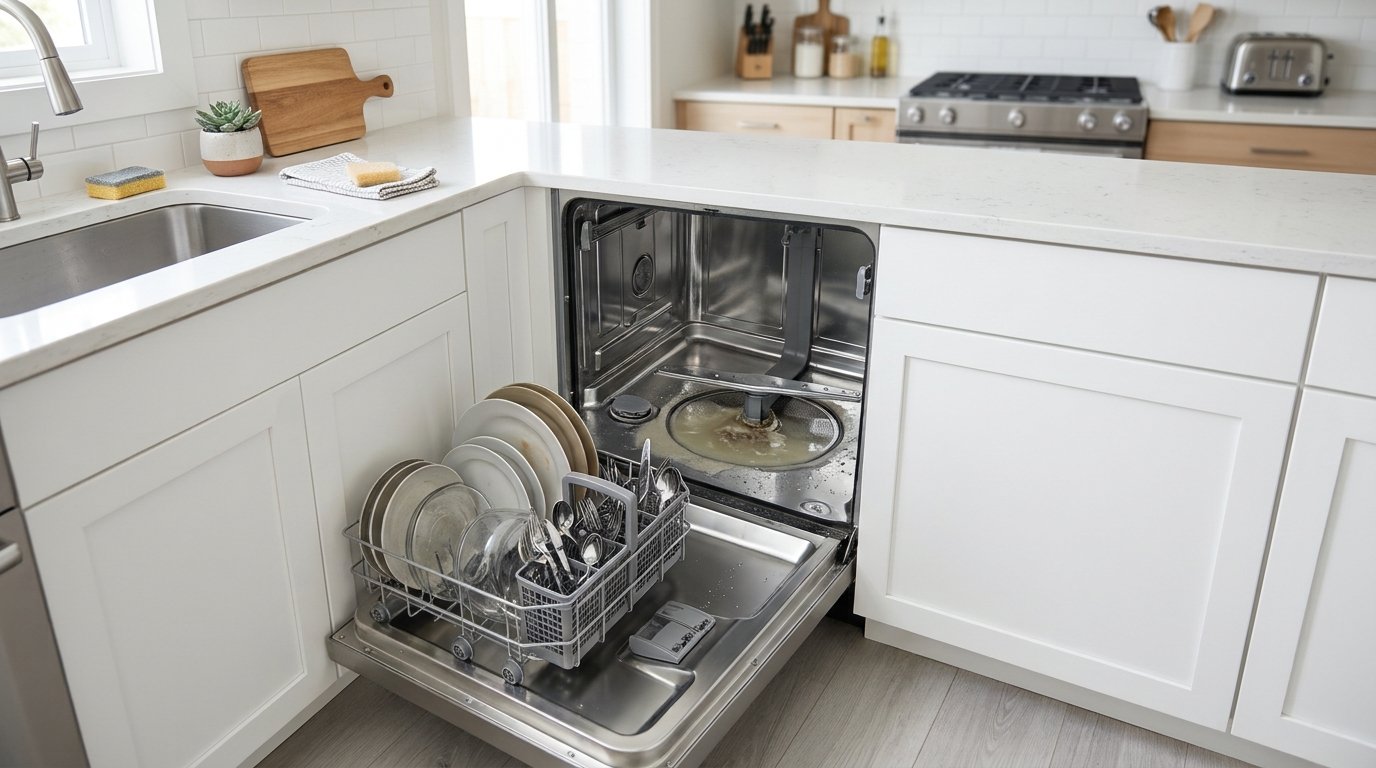
You open the dishwasher after a full cycle and there it is: a pool of cloudy, smelly water sitting at the bottom. A dishwasher not draining is one of the most common kitchen problems, and the good news is that it’s usually not the pump dying. Nine times out of ten, something is simply in the way.
Quick answer: start with the filter at the bottom of the tub. If that’s clean, check the drain hose for kinks and run your garbage disposal. Those three checks fix most dishwashers that won’t drain.
If that didn’t do it, work through the rest of this list in order. It goes from the quickest, free fixes to the ones that might need a technician.
Before you start: stay safe
- Turn the dishwasher off and unplug it or switch off its circuit breaker before you put your hands inside.
- Grab some old towels and a cup or small pan to scoop out the water. It’s messy, so expect a bit on the floor.
- Wear gloves if you have them. Broken glass loves to hide around the filter.
1. Cancel and restart the cycle
Sometimes the dishwasher just stopped halfway, after a short power cut or because someone opened the door to throw in one more mug. Many models have a Cancel or Cancel/Drain option. On some it’s a button, on others you hold Start for a few seconds, so check your manual. Let it run for a couple of minutes and see if the water goes.
2. Clean the filter (the usual culprit)
Most people never clean their dishwasher filter, and that’s exactly why it clogs. Bits of food, paper labels from jars and tiny pieces of glass all end up there.
- Pull out the bottom rack.
- Twist the round filter and lift it out, along with the flat mesh underneath it.
- Rinse both under warm water and give them a gentle scrub with an old toothbrush.
- Feel inside the hole under the filter for anything stuck, then put the filter back and twist it until it locks.
Make a habit of doing this once a month. It takes two minutes and stops most drain problems before they start.
3. Run the garbage disposal
If your dishwasher drains through a garbage disposal, leftover food in the disposal can block the water. Run the disposal with cold water for 20–30 seconds, then try draining the dishwasher again.
Just had a new disposal fitted? This one catches a lot of people out. New disposals come with a plastic knockout plug inside the dishwasher inlet. If the installer didn’t knock it out, the dishwasher has nowhere to drain. It’s removed from inside the inlet with the disposal unplugged. Check the disposal’s manual or call the installer back.
4. Check the drain hose for kinks
Follow the ribbed drain hose from the dishwasher to the sink. Look under the sink and, if you can, slide the dishwasher out a little. A hose that’s been bent flat, squashed by bottles under the sink or pinched when the dishwasher was pushed back can stop the water completely.
The hose should also rise up high under the counter before it drops down to the drain. This is called a high loop, and it stops dirty sink water from running back into the dishwasher.
5. Clear the air gap
Some kitchens have a small chrome cap on the sink or counter, next to the faucet. That’s the air gap. Pull or twist the cover off and clean out any gunk. If you’ve noticed water spurting into the sink when the dishwasher drains, a blocked air gap is very likely the reason.
6. Check the kitchen sink drain
Your dishwasher usually shares a drain with the sink. If the sink is slow to empty too, the blockage is in the plumbing, not the dishwasher. Clear the sink drain first, then run the dishwasher again.
7. Listen to the drain pump
Start a drain or cancel cycle and put your ear near the bottom of the machine:
- Humming, but no water moving: something is probably stuck in the pump, like a piece of glass, a cherry pit or a small bone. On many models you can reach the pump cover under the filter and remove the debris carefully.
- Silence: the pump may have failed, or it isn’t getting power. That usually means a new pump or a technician.
- Normal pumping sound, but the water stays: the blockage is further along, in the hose, air gap, disposal or sink drain.
8. Look up the error code
Many dishwashers show a drain error on the display, or flash their lights in a pattern. Every brand uses different codes, so look up your exact code in the manual or on the manufacturer’s support page. It tells you whether the machine thinks the problem is the pump, the filter or a sensor.
💡 Tip: Scrape plates into the bin instead of rinsing them in the sink. Big food scraps are what clog the filter, and modern dishwashers handle the small bits just fine.
When it’s time to call a technician
- The drain pump makes no sound at all, or it’s visibly damaged.
- Water is leaking out from under the dishwasher.
- You smell burning, or the dishwasher keeps tripping the breaker.
- You’ve tried everything above and it still won’t drain.
Dishwasher not draining: quick FAQ
Is a little water in the bottom normal?
Yes. A small amount of clean water around the filter is normal on many models, because it keeps the seals from drying out. A few centimetres (an inch or more) of dirty water isn’t.
Can I pour drain cleaner into the dishwasher?
Please don’t. Chemical drain cleaners can damage the pump, seals and hoses. Clean the filter and clear blockages by hand instead.
Why does my dishwasher drain into the sink?
Usually because the air gap or the shared sink drain is blocked, or the drain hose doesn’t have a high loop.
Related guides: Why Is My Smoke Detector Beeping? · Washing Machine Not Spinning? Causes and Fixes